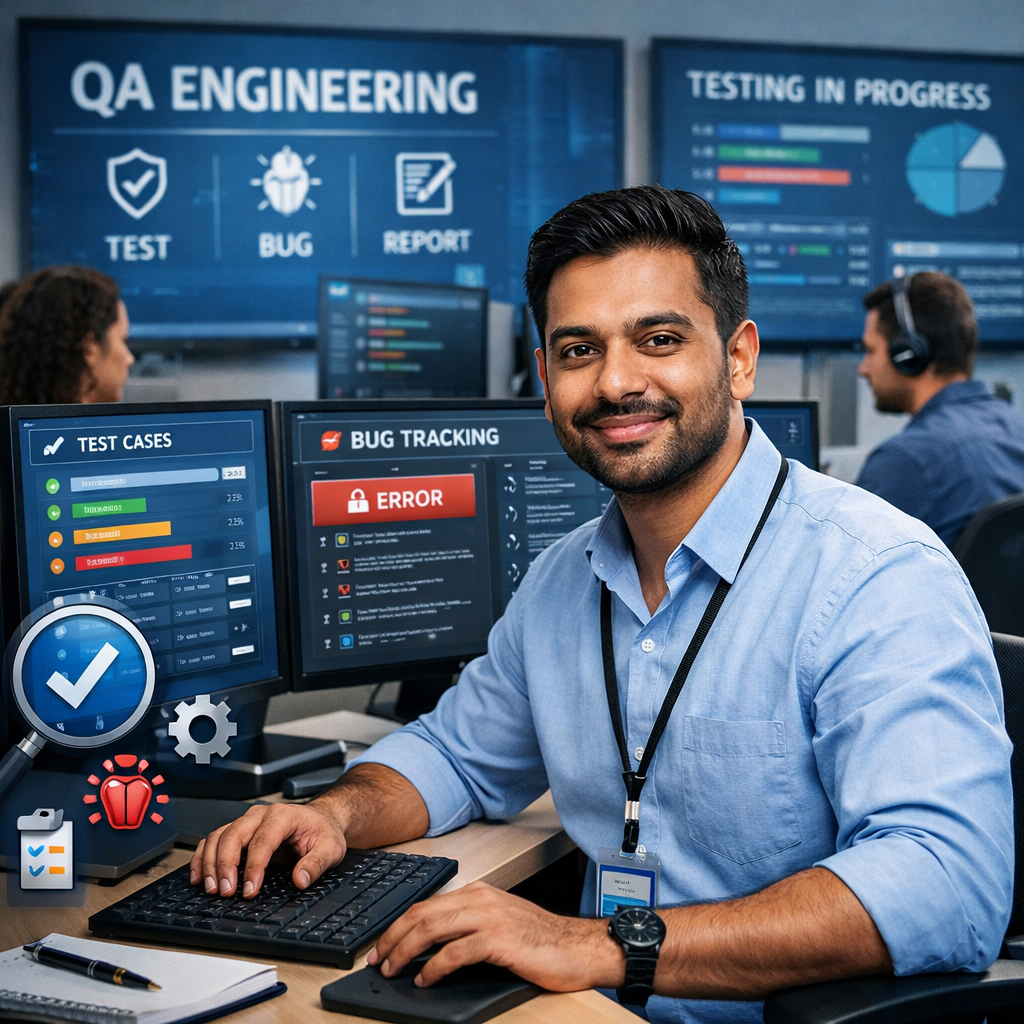
Elevate software quality with expert QA engineering. From AI-driven test automation and
performance testing to security audits, we ensure seamless user experiences.
Elevate software quality with expert QA engineering. From AI-driven test automation and performance testing to security audits, we ensure seamless user experiences.
n the high-speed world of CI/CD, quality cannot be an afterthought. Our QA engineering services redefine the traditional testing lifecycle by embedding quality directly into your development pipeline. By adopting a “Shift-Left” approach, our engineers collaborate with your developers from the design phase, identifying potential flaws before a single line of code is written. We move beyond manual checklists to architect intelligent automation frameworks that provide real-time feedback, allowing your team to deploy updates with absolute confidence and speed.
We leverage the latest in AI-augmented testing to solve the most common bottleneck: test maintenance. Our frameworks utilize self-healing scripts and predictive analytics to anticipate where failures might occur, drastically reducing the manual effort required to keep test suites current.
Sneak Peek into our Innovative Journey
Technologies Covered
0+
Projects Delivered
0+
Hours Worked
0M+
Client Retention Rate
0%
QA Engineering Core Features
Building Resilient, Self-Healing Quality Gates
Test automation is only as valuable as its reliability. We move beyond brittle, high-maintenance scripts by architecting Object-Oriented Automation Frameworks that scale. Using tools like Selenium, Playwright, or Cypress, we implement ‘Self-Healing’ mechanisms that use AI to detect UI changes and update element locators automatically. This drastically reduces ‘test flakiness’ and maintenance overhead, ensuring your CI/CD pipeline provides fast, trustworthy feedback on every code commit.
Custom Framework Development: Modular architectures using Page Object Model (POM) or Screenplay patterns.
Behavior-Driven Development (BDD): Using Gherkin (Cucumber/SpecFlow) to align developers, QA, and stakeholders.
Parallel Execution: Scaling tests across cloud grids to reduce execution time from hours to minutes.
Automated Regression: Comprehensive suites that guard your critical business paths 24/7.
Ensuring System Resilience Under Extreme Load
Quality isn’t just about functional correctness; it’s about how your system behaves under pressure. Our Performance Engineering services go beyond simple load testing to identify the root causes of latency and system failure. We simulate real-world traffic patterns to conduct Stress, Spike, and Soak testing, uncovering memory leaks, database bottlenecks, and thread contention. We provide actionable insights that help your DevOps team right-size infrastructure and optimize code for maximum throughput.
Load Simulation: Scalable testing with JMeter, K6, or Locust to mimic thousands of concurrent users.
Scalability Analysis: Determining the ‘breaking point’ of your cloud or on-prem architecture.
Real User Monitoring (RUM): Correlating synthetic test results with actual user experience metrics.
Infrastructure Benchmarking: Validating auto-scaling policies and database response times.
Leveraging Generative AI for Intelligent Quality Assurance
In 2026, QA is powered by intelligence. We integrate AI and Machine Learning into the testing lifecycle to solve complex quality challenges. From Generative AI that creates comprehensive test data and edge-case scenarios to Predictive Analytics that identify which areas of your application are most likely to fail after a change, we help you test smarter. This ‘Risk-Based’ approach ensures that your testing effort is always focused on the most critical components of your software.
Visual Regression Testing: Using AI-powered tools (like Applitools) to detect visual bugs that code-based tests miss.
Intelligent Test Generation: Using LLMs to write boilerplate test code and documentation.
Defect Prediction: Analyzing historical data to pinpoint high-risk code modules.
Smart Test Selection: Running only the tests impacted by a specific code change to save time and resources.
Hardening Quality and Security Early in the Lifecycle
The most cost-effective way to fix a bug is to never let it enter the codebase. Our Shift-Left strategy embeds QA engineers into the requirement and design phases. We implement Static Code Analysis and Contract Testing (using Pact) to ensure microservices communicate correctly before they are even deployed. Furthermore, we integrate Security Testing (DAST/SAST) into the pipeline, ensuring that vulnerability scanning is a continuous process rather than a final hurdle.
API & Microservices Testing: Validating headless layers via Postman, RestAssured, or Karate.
Contract Testing: Ensuring independent service evolution without breaking dependencies.
Continuous Security: Automated OWASP Top 10 scans within the development workflow.
TDD/Unit Testing Support: Partnering with developers to increase code coverage and reliability.
Trusted by
Industry Leaders
FAQS
Uncover Answers to Your QA Engineering Questions
Get answers to all your questions related to QA Enginnerig Services. If you still have queries, feel free to connect with us at contact@intellious.tech
What is the difference between QA and QA Engineering?
Traditional QA often focuses on finding bugs through manual execution. QA Engineering is a highly technical discipline that focuses on building systems, tools, and automated frameworks to prevent bugs and streamline the entire development process.
How do you decide what to automate and what to test manually?
We use a Risk-Based Testing strategy. High-volume, repetitive, and critical-path scenarios (like checkout or login) are prioritized for automation. Exploratory testing, UI/UX feel, and new feature discovery are handled by our expert manual testers.
Can you integrate QA into our existing CI/CD pipeline?
Yes. We specialize in integrating automated test suites directly into tools like Jenkins, GitLab CI, or CircleCI. This ensures that every code commit triggers a “Quality Gate,” preventing unstable code from ever reaching your production environment.
How do you handle testing for AI and Machine Learning models?
Testing AI requires a different approach focused on Data Validation and Model Drift. We implement specialized QA workflows that test the accuracy, bias, and performance of your models against diverse datasets to ensure reliable outputs.
Build confidence with intelligent QA engineering
Implement automated and manual testing strategies to detect issues early and accelerate releases.
Implement automated and manual testing strategies to detect issues early and accelerate releases.